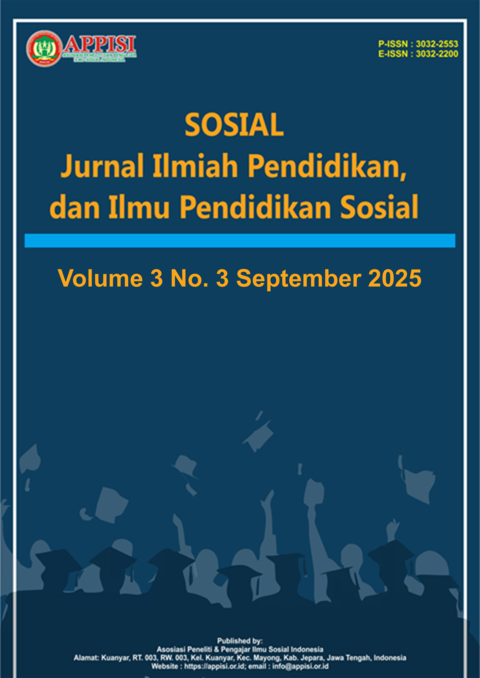
Implementasi Model Pembelajaran Sains, Technology, Engineering, and Mathematics (STEM) pada Mata Pelajaran IPS dalam Meningkatkan Hasil Belajar Peserta Didik di SMP Negeri 3 Jakarta
DOI:
https://doi.org/10.62383/sosial.v3i3.1048Keywords:
classroom action, innovative learning, learning outcomes, social studies, STEM approachAbstract
This study aims to improve students' learning outcomes in Social Sciences (IPS) through the implementation of the Science, Technology, Engineering, and Mathematics (STEM) learning model. The background of this study is based on the low learning outcomes of IPS in class VII of SMP Negeri 3 Jakarta, as well as the lack of variations in innovative learning models. The study used the Classroom Action Research (CAR) method of the Kemmis and McTaggart model which was carried out in two cycles. Each cycle includes the stages of planning, implementation, observation, and reflection. The subjects of the study were 36 class VII-B students. Data collection techniques used learning outcome tests, observations, interviews, and documentation. The results of the study showed a significant increase in student learning outcomes. In the first cycle, the percentage of students who achieved the Minimum Completion Criteria (KKM) was 77.77%, increasing to 91.6% in the second cycle. In addition, student activity in learning activities also increased. These results prove that the Science, Technology, Engineering, and Mathematics (STEM) learning model is able to integrate social studies concepts with real situations, thus facilitating students' understanding and improving the quality of learning.
Downloads
References
Arikunto, S., Supardi, & Suhardjono. (2015). Penelitian Tindakan Kelas (Suryani, Ed.; Revisi).
Gunawan, I., & Murdiyah, S. (2018). Peningkatan Hasil Belajar Dan Motivasi Belajar Siswa Melalui Model Behavior Modification. Jurnal Kajian Teori Dan Praktik Kependidikan, 3(2).
Ishak. (2022). The Effectiveness Of Cooperative Learning Number Head Together In English Subject In Junior High School. Journal Inovasi Pendidikan Dan Pengajaran.
Jauhariyyah, F. R. A., Suwono, H., & Ibrohim, I. (2017). Science, Technology, Engineering and Mathematics Project Based Learning (STEM-PjBL) Pada Pembelajaran Sains. . In Seminar Nasional Pendidikan IPA 2017, 432–435.
Kelley, T. R., & Knowles, J. G. (2016). A conceptual framework for integrated STEM education. In International Journal of STEM Education (Vol. 3, Issue 1). Springer. https://doi.org/10.1186/s40594-016-0046-z
Marlina, L., & Sholehun. (2021). Analisis Faktor-Faktor Yang Mempengaruhi Hasil Belajar Bahasa Indonesia Pada Siswa Kelas Iv Sd Muhammadiyah Majaran Kabupaten Sorong.
Mulyani, T. (2019). Model Pembelajaran STEM untuk menghadapi Revolusi Industry 4.0. Seminar Nasional Pascasarjana.
Saputra, N. (2021). Penelitian Tindakan Kelas (M. Arif, Ed.).
Shernoff, D. J., Sinha, S., Bressler, D. M., & Ginsburg, L. (2017). Assessing teacher education and professional development needs for the implementation of integrated approaches to STEM education. International Journal of STEM Education, 4(1). https://doi.org/10.1186/s40594-017-0068-1
Sofia, D., Pinem, I., Mailani, E., & Florentina, N. (2024). Penelitian Tindakan Kelas (Sepriano & Efitra, Eds.).
Downloads
Published
How to Cite
Issue
Section
License
Copyright (c) 2025 SOSIAL : Jurnal Ilmiah Pendidikan IPS

This work is licensed under a Creative Commons Attribution-ShareAlike 4.0 International License.