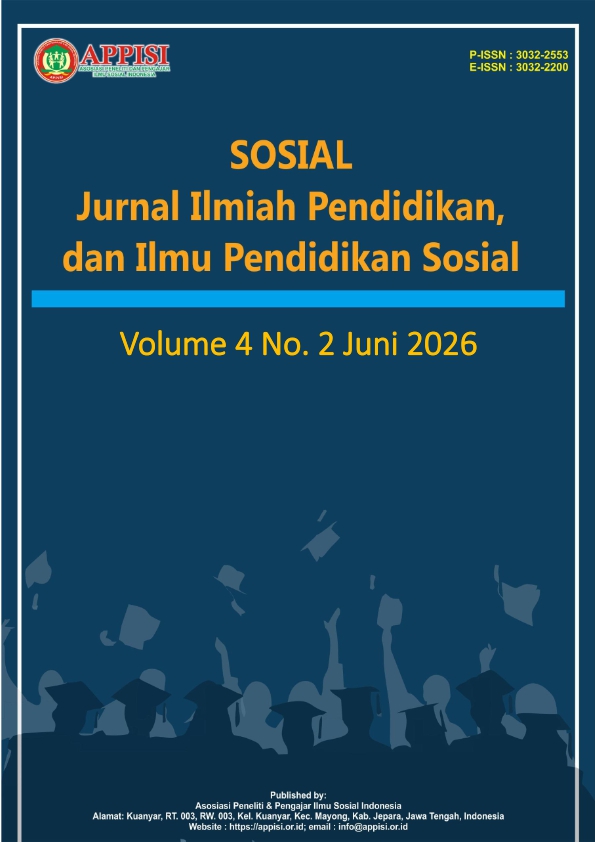
Penggunaan Quiz Edukatif Sebagai Inovasi Pembelajaran untuk Meningkatkan Pemahaman Konsep Ekosistem
DOI:
https://doi.org/10.62383/sosial.v4i2.1723Keywords:
Ecosystem, Educational Quiz, Elementary School, Learning Innovation, Science LearningAbstract
The use of innovative learning media is important in improving students’ understanding of ecosystem concepts in elementary science learning. However, science learning activities in elementary schools are still dominated by conventional teaching methods, causing students to become less active during lessons. This study aims to analyze the use of educational quizzes as a learning innovation to improve students’ understanding of ecosystem concepts. This research employed a descriptive qualitative approach. Data collection techniques were conducted through observation, interviews, documentation, and analysis of student quiz results. The findings indicate that educational quizzes were able to increase students’ enthusiasm, participation, concentration, and understanding of ecosystem materials such as food chains, food webs, producers, consumers, and decomposers. Students became more active in answering questions and showed higher motivation during the learning process. Educational quizzes also helped teachers evaluate students’ understanding more effectively and interactively. Therefore, educational quizzes can be used as an effective and enjoyable learning innovation to improve students understanding of ecosystem concepts in elementary science learning.
Downloads
References
Arikunto, S. (2020). Prosedur penelitian: Suatu pendekatan praktik. Rineka Cipta.
Arsyad, A. (2020). Media pembelajaran. Rajawali Pers.
Bloom, B. S. (1956). Taxonomy of educational objectives: The classification of educational goals. Longmans.
Bruner, J. S. (1960). The process of education. Harvard University Press. https://doi.org/10.4159/9780674028999
Creswell, J. W. (2020). Educational research: Planning, conducting, and evaluating quantitative and qualitative research. Pearson.
Daryanto. (2021). Media pembelajaran inovatif. Gava Media.
Dimyati, & Mudjiono. (2018). Belajar dan pembelajaran. Rineka Cipta.
Djamarah, S. B. (2018). Psikologi belajar. Rineka Cipta.
Gagné, R. M. (1985). The conditions of learning. Holt, Rinehart and Winston.
Hamalik, O. (2019). Proses belajar mengajar. Bumi Aksara.
Kunandar. (2013). Penelitian tindakan kelas. Rajawali Pers.
Majid, A. (2021). Strategi pembelajaran. Remaja Rosdakarya.
Miles, M. B., & Huberman, A. M. (2014). Qualitative data analysis. Sage.
Nurgiyantoro, B. (2010). Penilaian pembelajaran bahasa. BPFE.
Piaget, J. (2020). The psychology of the child. Basic Books.
Rusman. (2021). Model-model pembelajaran. Rajawali Pers.
Sanjaya, W. (2020). Strategi pembelajaran berorientasi standar proses pendidikan. Kencana.
Slameto. (2019). Belajar dan faktor-faktor yang mempengaruhinya. Rineka Cipta.
Sudjana, N. (2021). Penilaian hasil proses belajar mengajar. Remaja Rosdakarya.
Sugiyono. (2022). Metode penelitian pendidikan. Alfabeta.
Suprijono, A. (2020). Cooperative learning: Teori dan aplikasi PAIKEM. Pustaka Pelajar.
Susanto, A. (2020). Teori belajar dan pembelajaran di sekolah dasar. Prenadamedia Group.
Trianto. (2018). Model pembelajaran terpadu. Bumi Aksara.
Uno, H. B. (2020). Model pembelajaran. Bumi Aksara.
Vygotsky, L. S. (1978). Mind in society: The development of higher psychological processes. Harvard University Press.
Winkel, W. S. (2019). Psikologi pengajaran. Grasindo.
Downloads
Published
How to Cite
Issue
Section
License
Copyright (c) 2026 SOSIAL: Jurnal Ilmiah Pendidikan IPS

This work is licensed under a Creative Commons Attribution-ShareAlike 4.0 International License.