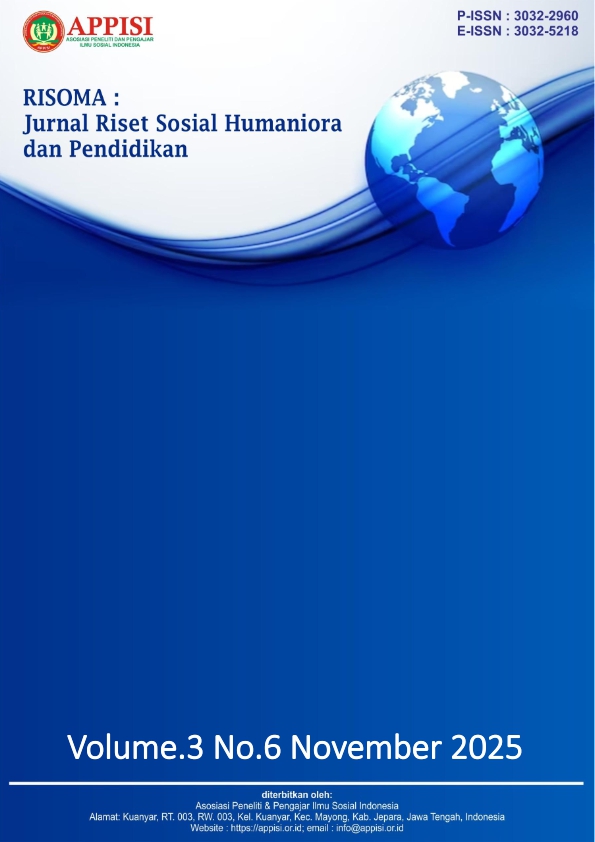
Dukungan Otonomi Sistem dan Keberlanjutan Penggunaan LMS di Pendidikan Tinggi : Kajian Kualitatif Berbasis Self-Determination Theory
DOI:
https://doi.org/10.62383/risoma.v3i6.1237Keywords:
Digital Learning Continuance, Higher Education, Learning Management System, Self-Determination Theory, System-Provided Autonomy SupportAbstract
Digital transformation in higher education demands the sustainable use of Learning Management Systems (LMS). However, most previous studies have predominantly focused on cognitive aspects such as perceived usefulness and user satisfaction, overlooking the motivational dimensions that drive long-term engagement. This study aims to explore how System-Provided Autonomy Support (S-PAS)—the degree of autonomy support embedded within the system—shapes users’ continuance intention to use LMS through psychological need satisfaction and autonomous motivation. Employing an exploratory qualitative approach, data were collected through in-depth interviews, focus group discussions (FGDs), task-based observations, and critical discourse analysis of institutional policies and system micro-copies across several universities under the coordination of LLDIKTI Region IX Sultanbatara. Thematic analysis revealed that users’ experiences with LMS are influenced by five key dimensions of S-PAS: meaningful choice, rationale provision, non-controlling language, emotional validation, and informational feedback. When the system and policies offer flexibility, empathetic communication, and clear rationales behind instructions, users exhibit higher levels of autonomous motivation and stronger commitment to LMS continuance. Conversely, administrative rigidity, technostress, and opaque surveillance practices undermine psychological need satisfaction and weaken users’ continuance intention. The study extends the application of Self-Determination Theory (SDT) to educational technology by introducing S-PAS as a conceptual framework that bridges system design and user motivation. Practically, the findings offer strategic guidance for policymakers and developers to design LMS environments that are more autonomy-supportive, human-centered, and sustainable. Future research is encouraged to quantitatively validate the S-PAS model across diverse institutional and cultural contexts to enhance the generalizability and theoretical robustness of these findings.
Downloads
References
Bhattacherjee, A. (2001). Understanding information systems continuance: An expectation-confirmation model. MIS Quarterly, 25(3), 351-370. https://doi.org/10.2307/3250921
Bhattacherjee, A., & Lin, C.-P. (2015). A unified model of IT continuance: Three complementary perspectives and crossover effects. European Journal of Information Systems, 24(4), 364-373. https://doi.org/10.1057/ejis.2013.36
Braun, V., & Clarke, V. (2019). Reflecting on reflexive thematic analysis. Qualitative Research in Sport, Exercise and Health, 11(4), 589-597. https://doi.org/10.1080/2159676X.2019.1628806
Chirkov, V. I., Ryan, R. M., Kim, Y., & Kaplan, U. (2003). Differentiating autonomy from individualism and independence: A self-determination theory perspective on internalization of cultural orientations and well-being. Journal of Personality and Social Psychology, 84(1), 97-110. https://doi.org/10.1037/0022-3514.84.1.97
Deci, E. L., & Ryan, R. M. (1985). Intrinsic motivation and self-determination in human behavior. Springer. https://doi.org/10.1007/978-1-4899-2271-7
Deci, E. L., & Ryan, R. M. (2000). The "what" and "why" of goal pursuits: Human needs and the self-determination of behavior. Psychological Inquiry, 11(4), 227-268. https://doi.org/10.1207/S15327965PLI1104_01
Gagné, M., & Deci, E. L. (2005). Self-determination theory and work motivation. Journal of Organizational Behavior, 26(4), 331-362. https://doi.org/10.1002/job.322
Reeve, J. (2006). Teachers as facilitators: What autonomy-supportive teachers do and why their students benefit. The Elementary School Journal, 106(3), 225-236. https://doi.org/10.1086/501484
Ryan, R. M., & Deci, E. L. (2017). Self-determination theory: Basic psychological needs in motivation, development, and wellness. Guilford Press. https://doi.org/10.1521/978.14625/28806
Tarafdar, M., Cooper, C. L., & Stich, J. F. (2019). The technostress trifecta: Techno eustress, techno distress and design. Information Systems Journal, 29(1), 6-42. https://doi.org/10.1111/isj.12169
Tarafdar, M., Pullins, E. B., & Ragu-Nathan, T. S. (2015). Technostress: Negative effect on performance and possible mitigations. Information Systems Journal, 25(2), 103-132. https://doi.org/10.1111/isj.12042
Tarigan, R., & Syahnur, H. (2024). System-provided autonomy support and digital learning continuance among lecturers: Exploring the moderating role of technostress and surveillance perception. Journal of Digital Education and Innovation, 3(2), 55-70.
Van den Broeck, A., Ferris, D. L., Chang, C. H., & Rosen, C. C. (2016). A review of self-determination theory's basic psychological needs at work. Journal of Management, 42(5), 1195-1229. https://doi.org/10.1177/0149206316632058
Van den Broeck, A., Howard, J. L., & Gagné, M. (2021). Understanding the bright and dark sides of work motivation: The role of need satisfaction and need frustration. Journal of Organizational Behavior, 42(2), 179-197. https://doi.org/10.1002/job.2486
Van der Heijden, B., & Kocaoglu, D. F. (2021). Understanding employee continuance intention toward digital learning platforms: A self-determination theory approach. Computers & Education, 164, 104112. https://doi.org/10.1016/j.compedu.2020.104112
Vansteenkiste, M., & Ryan, R. M. (2013). On psychological growth and vulnerability: Basic psychological need satisfaction and need frustration as a unifying principle. Journal of Psychotherapy Integration, 23(3), 263-280. https://doi.org/10.1037/a0032359
Williams, G. C., & Deci, E. L. (1996). Internalization of biopsychosocial values by medical students: A test of self-determination theory. Journal of Personality and Social Psychology, 70(4), 767-779. https://doi.org/10.1037/0022-3514.70.4.767
Downloads
Published
How to Cite
Issue
Section
License
Copyright (c) 2025 RISOMA : Jurnal Riset Sosial Humaniora dan Pendidikan

This work is licensed under a Creative Commons Attribution-ShareAlike 4.0 International License.